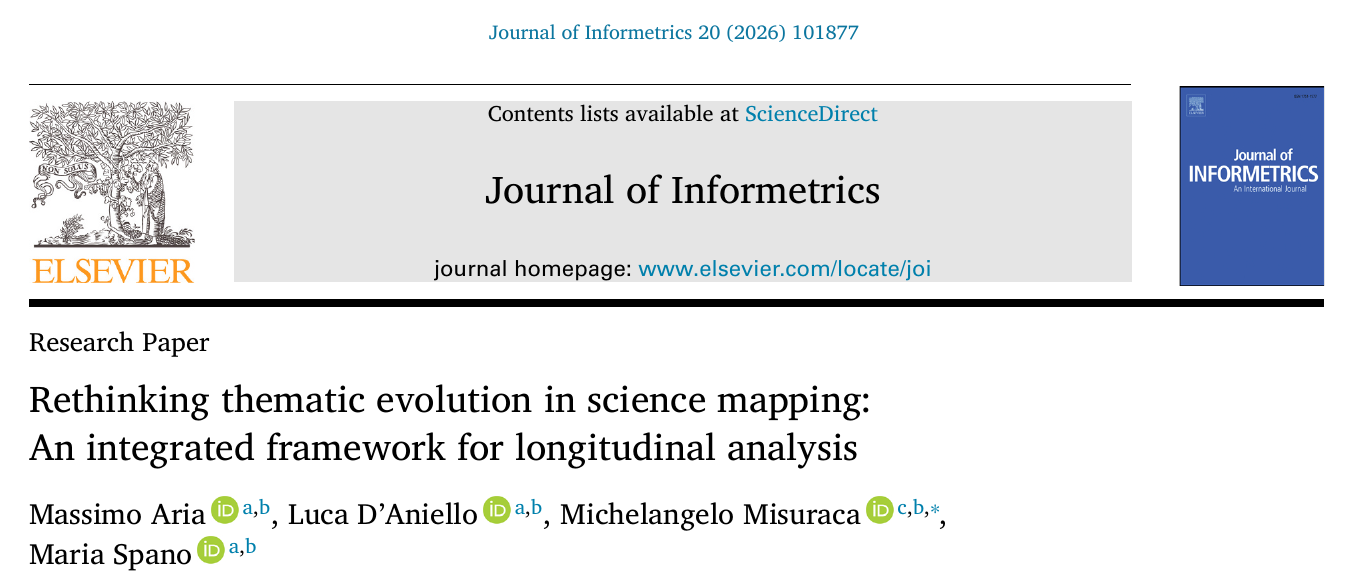
Our paper "Rethinking thematic evolution in science mapping: An integrated framework for longitudinal analysis" is now out, open access, in the Journal of Informetrics (Elsevier), written together with Massimo Aria, Michelangelo Misuraca and Maria Spano. Some of you may have already read it as a preprint on arXiv: this is the peer-reviewed, published version.
A hidden inconsistency
Strategic diagrams and co-word analysis are among the most widely used tools to describe the conceptual structure of a research field and how it changes over time. Yet the way they are usually applied longitudinally hides an inconsistency: themes are detected through relational clustering in weighted keyword networks, but the links between themes in successive periods are inferred from a much simpler criterion, the set-theoretic overlap of keywords or core documents.
In other words, we build themes with one logic and then connect them across time with another. The result is that thematic evolution often ends up tracking the persistence of surface vocabulary rather than the actual reconfiguration of the intellectual structure.
One relational architecture, from detection to lineage
The framework we propose embeds lineage reconstruction within the same weighted relational architecture used to detect themes in each period. Thematic continuity is modelled through graded (fuzzy) document affiliation, so that a paper can contribute to more than one theme, and through a lineage-strength measure that combines directional thematic coverage with centrality-weighted structural coherence. Evolution becomes the reconfiguration of relational structures, not the survival of words.
Testing it on the Journal of Informetrics itself
As a testbed we used the complete publication record of the Journal of Informetrics from 2007 to 2025: 1,400 articles retrieved from the Web of Science, split into three periods. Compared with standard thematic analysis, the integrated framework captures differentiated split-and-merge dynamics that inclusion-based methods tend to obscure, and it reduces the hub-centred artefacts that arise when lineages are reconstructed from vocabulary alone.
Beyond the methodological point, we think this matters in practice: research evaluation, funding analysis and journal studies all rely on reading how themes emerge, consolidate, decline or merge, and a more coherent model of that process makes those readings more robust and easier to replicate.
It is a special pleasure to see this work published in the very journal whose history it maps, and I am grateful to Massimo, Michelangelo and Maria for the long discussions that shaped it.
Cite: Aria, M., D'Aniello, L., Misuraca, M., & Spano, M. (2026). Rethinking thematic evolution in science mapping: An integrated framework for longitudinal analysis. Journal of Informetrics, 20(4), 101877. DOI: 10.1016/j.joi.2026.101877