Our paper "Biblioshiny and the SAAS Workflow: An integrated framework for transparent and reproducible science mapping. A demonstration through the replication of a study" has been published in Journal of Informetrics (Elsevier), together with Massimo Aria, Corrado Cuccurullo and Maria Spano.
Science mapping is now widely used to review and structure scientific literature, but the analytical choices behind a map are often hard to trace and even harder to reproduce. This paper addresses that gap by framing the whole analysis as a structured, documented workflow built on top of Biblioshiny, the no-code, web-based interface of the bibliometrix R package.
The SAAS workflow
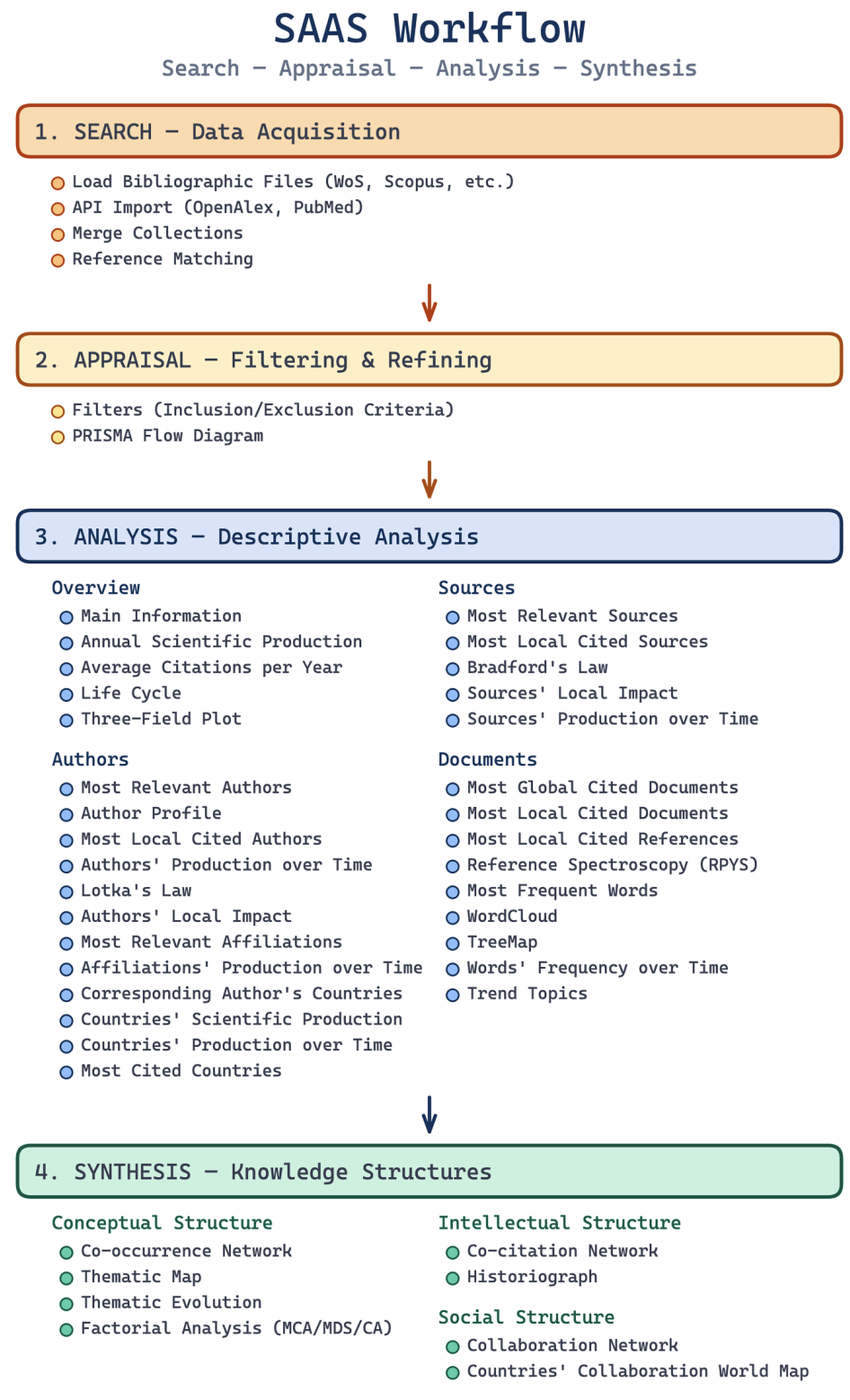
At the core of the paper is the SAAS workflow, a four-stage protocol that turns a science-mapping study into an explicit, sequential, and fully documented process: Search (data acquisition), Appraisal (filtering and refining), Analysis (descriptive analysis of authors, sources, and documents), and Synthesis (building the conceptual, intellectual, and social knowledge structures). Framing the analysis this way makes every decision, from data collection and cleaning to the choice of units, networks, and indicators, visible and repeatable, so that readers can understand exactly how a result was produced and reproduce it end to end.
Everything runs in Biblioshiny
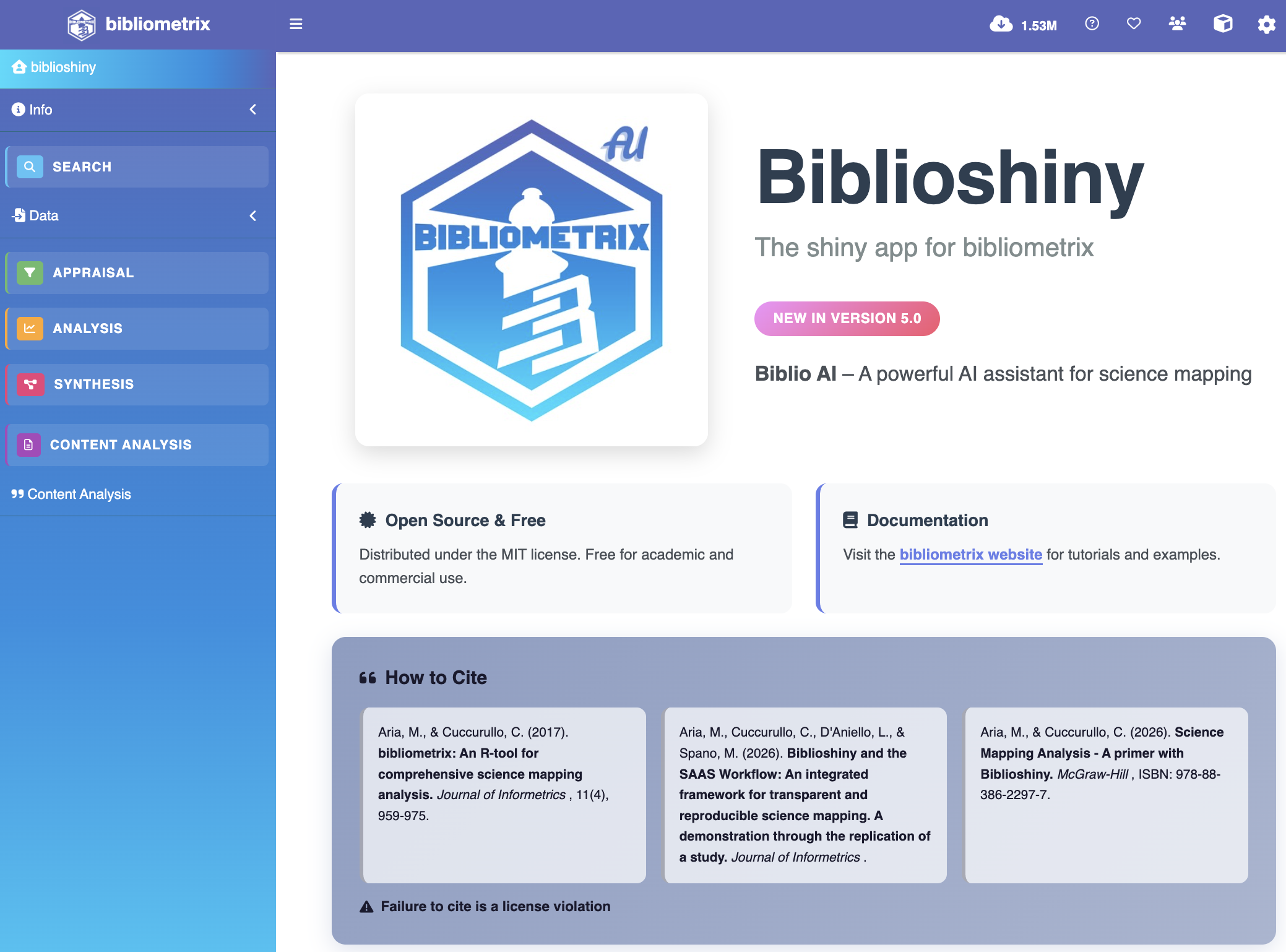
The whole workflow is carried out in Biblioshiny, the no-code, web-based interface of the bibliometrix R package. Biblioshiny lets researchers import data from Web of Science, Scopus, PubMed, and other sources, and move through the SAAS stages, appraisal, descriptive analysis, and the construction of knowledge structures, entirely through a graphical interface, with no programming required.
Learning by replication
To show the workflow in practice, the paper replicates an existing study step by step, reconstructing its analyses within Biblioshiny and discussing where and why choices matter. The replication doubles as a hands-on demonstration of how transparent, reproducible science mapping can be carried out without programming.
Cite: Aria, M., Cuccurullo, C., D'Aniello, L., & Spano, M. (2026). Biblioshiny and the SAAS Workflow: An integrated framework for transparent and reproducible science mapping. A demonstration through the replication of a study. Journal of Informetrics. DOI: 10.1016/j.joi.2026.101837